
How to Think Like Marcus Aurelius: Ten Pictures that Strike into the Heart of 'Meditations'
With ten pictures & with some more words than that -- &, of course, compliments to Mr Dog for the slop-title recommendation

I thought it would be a rather interesting exercise in decoration or literary illustration to create a sort of gallery of pictures which correspond with lines out of the Meditations of a man whom most of history remembered as Antoninus, but whom we remember more fully as Marcus Aurelius or Marcus Aurelius Antoninus.
I thought that such an exercise would be interesting or fruitful because pictures are not only vessels of beauty, but also of both history and truth, spiritual and earthly. Thus, in viewing a picture, we are often given opportunity for reflection upon both earthly and spiritual things. In paintings of both historical and spiritual lessons, we can find visual examples of lessons taught in texts such as Aurelius’s Meditations, as well as, as has been said, opportunity to talk longer than we could with only the book or the picture in front of us. That is, having both picture and text not only prolongs the manner in which one ordinarily could talk about any one thing, by having two resources, but creates a third possibility for consideration by the mingling of the two. E. g., having both a painting of Daniel in the den of the lions and a literary reflection on being content with living life as one finds it gives one the visual and textual opportunity to reflect, and marries the two in order to create a kind of offspring-reflection. Read on to see further proofs of this fact.
I had better say, before quoting from it, that I take from Méric Casaubon’s translation of the Meditations, which I find preferable to a good many others, and which was the first to put the profound writings of Emperor Aurelius into English.
Do not be Destroyed by Pleasure-Seeking
He also that pursues after pleasures, as that which is truly good and flies from pains, as that which is truly evil: is impious. For such a one must of necessity oftentimes accuse that common nature, as distributing many things both unto the evil, and unto the good, not according to the deserts of either: as unto the bad oftentimes pleasures, and the causes of pleasures; so unto the good, pains, and the occasions of pains. Again, he that feareth pains and crosses in this world, feareth some of those things which some time or other must needs happen in the world. And that we have already showed to be impious. And he that pursueth after pleasures, will not spare, to compass his desires, to do that which is unjust, and that is manifestly impious.
Book Nine, I
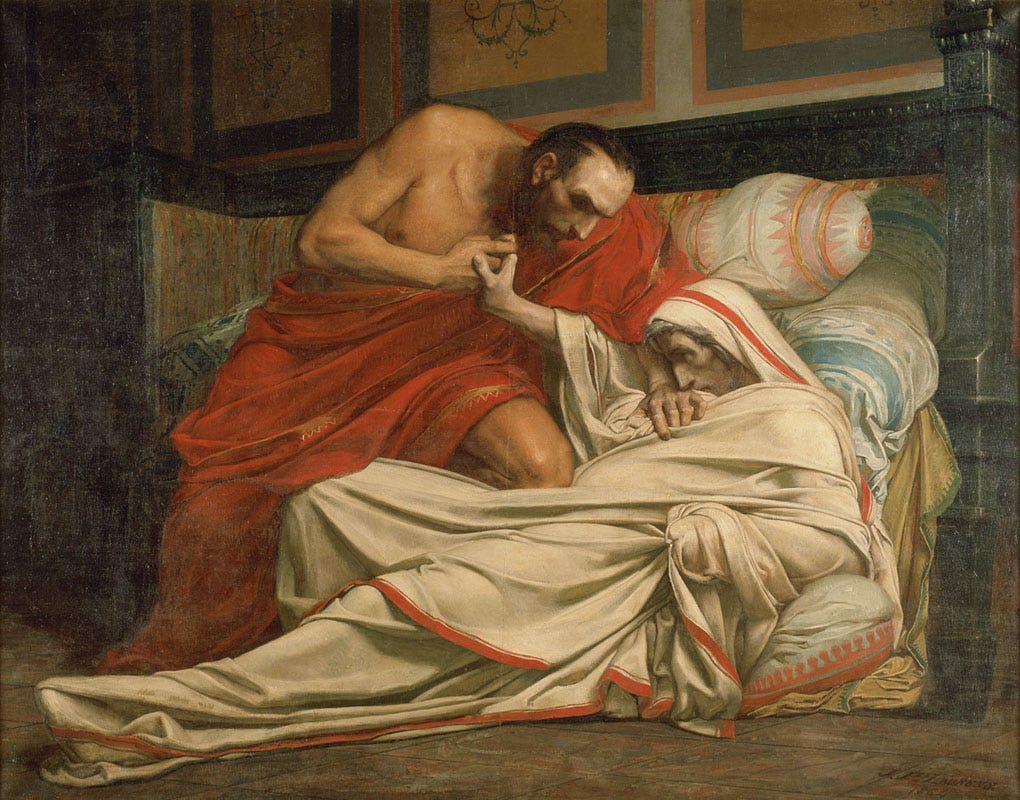
The Death of Tiberius, Jean-Paul Laurens, 1864. Caligula is seen standing over Tiberius and is seemingly removing his ring. Caligula is thus depicted as a usurper of the power of a weak man, Tiberius.
We know much about the debauched and mad reign of the Roman Emperor Caligula, but speak little of how that reign began. It was not out from behind the dust of nowhere that Caligula appeared in order to suddenly steal the reins of Rome’s Empire and begin guiding it in his memorably awful manner. Nay, he came forward in a rather tedious manner, having been trained to be as debauched, wicked, and self-obsessed as possible by no lesser a person than the Emperor of Rome, Tiberius.
In the latter years of his life and, thus, reign, Tiberius, once a hero of Rome and its able ruler, cared little for managing so complicated a thing as an Empire. So, one day, he set sail for Capri and failed ever to return to the mainland and the city of seven hills, Rome. On Capri, Tiberius allowed himself to be occupied with pleasures of all kinds. Indeed, not only did he allow himself to descend to occupation by this foreign and unfortunate spirit—that which wills undue pleasure-seeking; rather, he pursued after pleasures, as Aurelius warned against, perhaps recalling the memory of Tiberius and his regrettable heir, Caligula, whose wickedness Tiberius did little to guard against, but trained rather.
A Man Content with Suffering and Joy Alike— Blessed Therefore
O my soul, the time I trust will be, when thou shalt be good, simple, single, more open and visible, than that body by which it is enclosed. Thou wilt one day be sensible of their happiness, whose end is love, and their affections dead to all worldly things. Thou shalt one day be full, and in want of no external thing: not seeking pleasure from anything, either living or insensible, that this world can afford; neither wanting time for the continuation of thy pleasure, nor place and opportunity, nor the favour either of the weather or of men. When thou shalt have content in thy present estate, and all things present shall add to thy content: when thou shalt persuade thyself, that thou hast all things; all for thy good, and all by the providence of the Gods: and of things future also shalt be as confident, that all will do well, as tending to the maintenance and preservation in some sort, of his perfect welfare and happiness, who is perfection of life, of goodness, and beauty; who begets all things, and containeth all things in himself, and in himself doth recollect all things from all places that are dissolved, that of them he may beget others again like unto them. Such one day shall be thy disposition, that thou shalt be able, both in regard of the Gods, and in regard of men, so to fit and order thy conversation, as neither to complain of them at any time, for anything that they do; nor to do anything thyself, for which thou mayest justly be condemned.
Book Ten, I
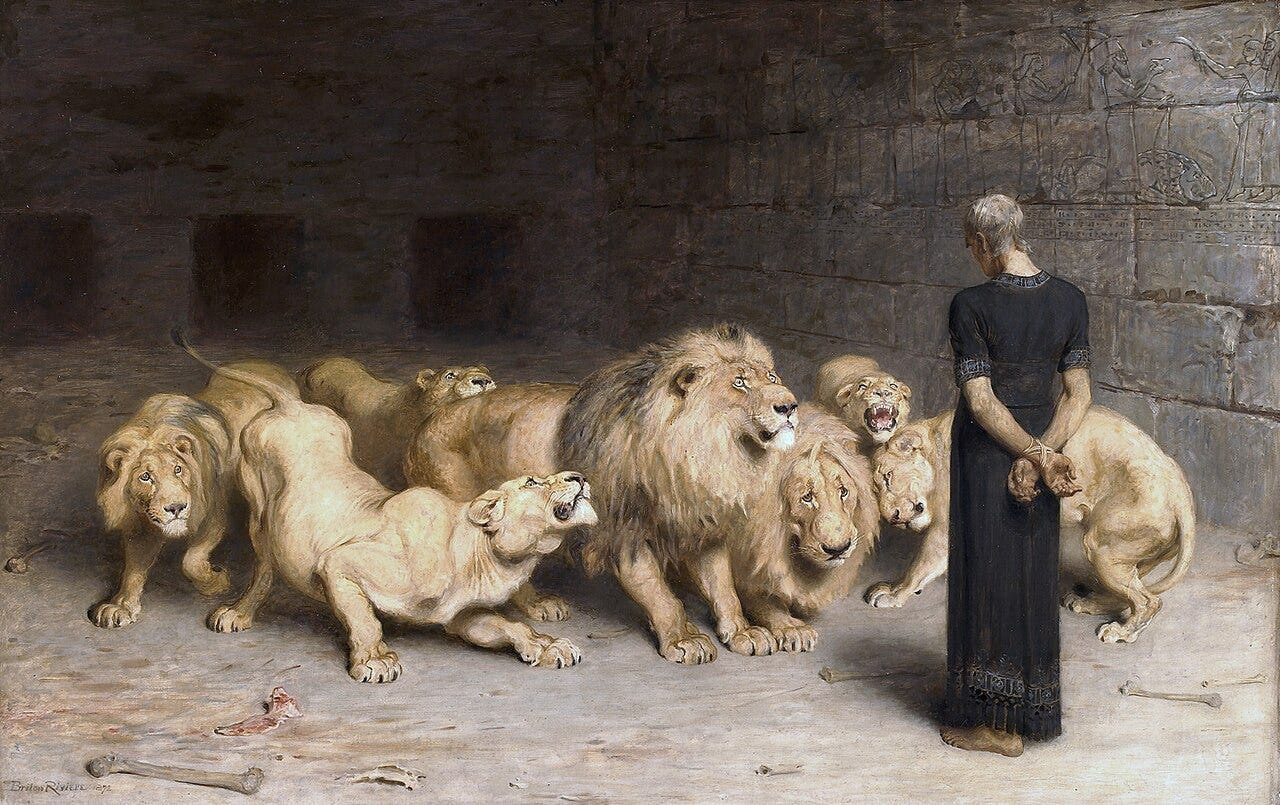
Daniel in the Lions’ Den, Briton Rivière, 1872
Aurelius prays rather strangely unto both himself and God at the same moment above. I cannot denounce his having done so, for we can say merely that he is making a vow unto himself and also God, that he might be kept doubly honest! Very often people leave it at the feet of God, as they are taught to do, but one must wonder as to the earthly effectiveness of doing so. After all, can one better clear one’s conscience—and, thus, better distract oneself thanks to a cleared conscience—if they leave all the sorrows and pains and sins with God and return to the world seemingly without them? I think so. Contrarily, Aurelius wants to be without the possibility of being dragged down by them, but he does not desire to forget all about them or hide them behind Divinity or some such excuse. Rather, he should like to see them as no part of himself, or at least not a part weighty enough to keep him from ever being better or more content than he was when sorrowful or sinful.
Aurelius discourses also on the promise, should one follow the path of virtue and acceptance of life as it is and as it shall be, that life shall be infinitely better when one is content and does not look to oneself as the master of all things nor the victor over fate and the Maker of it, as many today should like to be. Thus, we have Rivière’s Daniel, a man who certainly did not forget his contentedness or leave it behind him as he suffered, nor believed himself maker of all the world or the most complex of creatures, but rather lived simply and according to virtue, and persuaded himself that he all things, all for his good, and all by the providence of the Gods, were his. Daniel’s named wisdom and contentedness gained him rewards of a temporal and eternal nature, as Aurelius teaches one shall gain if one lives and believes as Daniel did.
Zarathustra Can Descend, and Should
A branch cut off from the continuity of that which was next unto it, must needs be cut off from the whole tree: so a man that is divided from another man, is divided from the whole society. A branch is cut off by another, but he that hates and is averse, cuts himself off from his neighbour, and knows not that at the same time he divides himself from the whole body, or corporation. But herein is the gift and mercy of God, the Author of this society, in that, once cut off we may grow together and become part of the whole again. But if this happen often the misery is that the further a man is run in this division, the harder he is to be reunited and restored again: and however the branch which, once cut of afterwards was graffed in, gardeners can tell you is not like that which sprouted together at first, and still continued in the unity of the body.
Book Eleven, VII
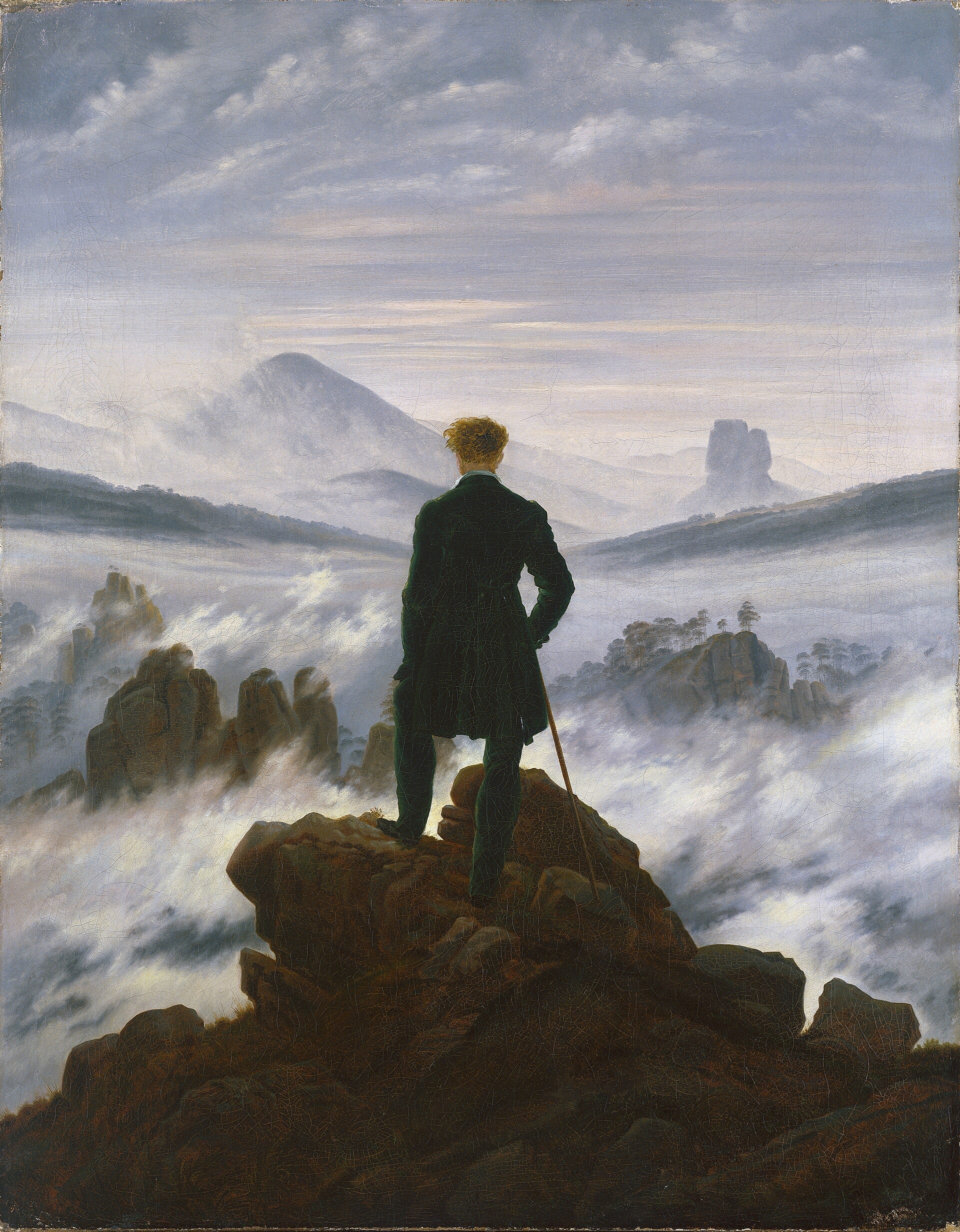
Wanderer above the Sea of Fog, Caspar David Friedrich, 1818
Perhaps it is peculiar to have here the picture of a man definitely cut off, Zarathustra-like, from society below, Caspar Friecdich’s Wanderer. But I think it should become less peculiar to us as an illustration when we reflect on the reminder—that of most moment in the meditation—that one, once cut off, can descend the mountain he climbed to cut himself off and can rejoin society.
Of course, one must say that David Friedrich meant not to paint Zarathustra—the detached man, the Übermensch, whom we are so often told we have a representation of in this painting. Rather, he meant to give us a picture of the fact that life is something mysterious and, ultimately, unable to control, no matter how much power or cash one might possess. Then, really, we find in the Wanderer a contemplative rather than sure man, and we can gain no real feeling as to his relationship with society, which he may have just departed from for a contemplative sojourn amongst the mountains, and which he may return to in the afternoon, that he might share in tea and sandwiches and discourse upon any fruitful contemplations made, or hear those of friends who reached certain other peaks, either literal or those shaped by the mind and heart. Nevertheless, we can be sure that his would have been the better fate if it was consumed not by the misery of loneliness but the contentedness of company and friendship, the latter of which Aurelius would have us embrace.
Sin Compared: Anger an Excuse Genuine and Not
Theophrastus, where he compares sin with sin (as after a vulgar sense such things I grant may be compared:) says well and like a philosopher, that those sins are greater which are committed through lust, than those which are committed through anger. For he that is angry seems with a kind of grief and close contraction of himself, to turn away from reason; but he that sins through lust, being overcome by pleasure, doth in his very sin bewray a more impotent, and unmanlike disposition. Well then and like a philosopher doth he say, that he of the two is the more to be condemned, that sins with pleasure, than he that sins with grief. For indeed this latter may seem first to have been wronged, and so in some manner through grief thereof to have been forced to be angry, whereas he who through lust doth commit anything, did of himself merely resolve upon that action.
Book Two, VII
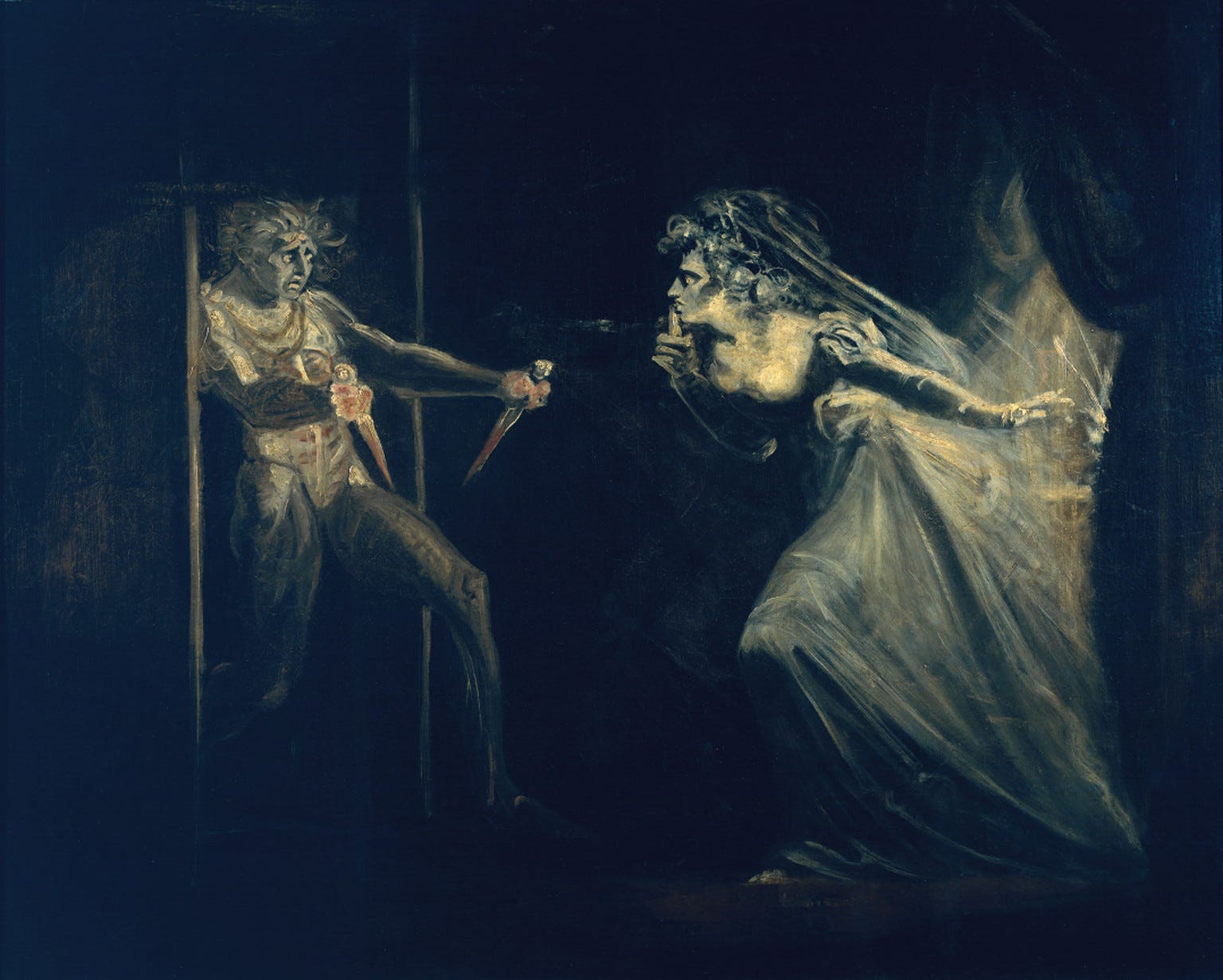
Lady Macbeth Seizing the Daggers, H. Fuseli, 1812
One must recognise truth as the inspiration for such a remark as that, even if the discourse on lust provides us but a miniature of the true nature of things—i. e., that voluntary sin, which ought to be defined as an embrace of that which is ill for one—in brief, a denial of not only one’s own life but the good of collective life and the embracing of that which is harmful to it—is much the worse than involuntary or half-voluntary sin, which cannot be strictly called selfish, even if it is an unconscious result of selfishness. That is so because when one thinks to do ill, one volunteers himself unto sin, whereas a person stricken with anger shall act at once and without thought, and thus sins less, even if his deed is as dreadful as he who committed the same sin consciously and had predetermined to do so. We have here an interesting illustration on account of the fact that we have a man, Macbeth, who certainly sinned on account of a manner of lust—that for power over a kingdom whose good he disrupted thanks to his lust—as well as anger and possession.
One thing I think ought to be said is this: people often throw themselves down in front of the altar of anger and devote themselves to its cultivation, either because it is natural to them to be angry or because they think anger a good mask for their sin. These people—we might think of Shakespeare’s Richard III—ought to be caught out and exposed as willing sinners. Of course, above we have a painting of another Shakespeare character, Macbeth. Shakespeare gives us Macbeth as the highest example of this masking of conscious sin in seemingly unconscious anger. I mean not the play altogether but the character of Macbeth himself. How often, we might recall, Macbeth allows himself to become angry and thus set himself up as blameless, even though he is hardly that, such as when he orders the murders of Banquo and Fleance and feigns a sort of outrage on behalf of the murderers, whose lives, he tells them, have had ruin introduced to them by Banquo. But also, it is sometimes so that Macbeth grows possessed by the spirit of anger, like a spell has fallen over him, and acts committed while under this spell ought certainly not to be counted as the severest of his crimes, for they were not wholly his. The finest example of this is given to us by Fuseli’s painting, for Macbeth’s murder of Duncan was certainly the work of a possessed spirit, whereas the ordering of the murders of Banquo and his son were those of a not then possessed man, but a horribly selfish and lustful man possessing command over his spirit. That the murder of Duncan was not wholly voluntary, of course, does little to redeem his murderer, for it is all the easier to be possessed by anger or spirits who would will that anger into one if one does nothing to defend oneself from it, such as by putting on the armour of virtue and charity, as Aurelius desires to teach in his above meditation and, indeed, each and all of them.
Judge Not the Uncontrollable, Lest You Cause a Hero to go Unborn
Be not angry neither with him whose breath, neither with him whose arm holes, are offensive. What can he do? such is his breath naturally, and such are his arm holes; and from such, such an effect, and such a smell must of necessity proceed. ‘O, but the man (sayest thou) hath understanding in him, and might of himself know, that he by standing near, cannot choose but offend.’ And thou also (God bless thee!) hast understanding. Let thy reasonable faculty, work upon his reasonable faculty; show him his fault, admonish him. If he hearken unto thee, thou hast cured him, and there will be no more occasion of anger.
Book Five, XXII
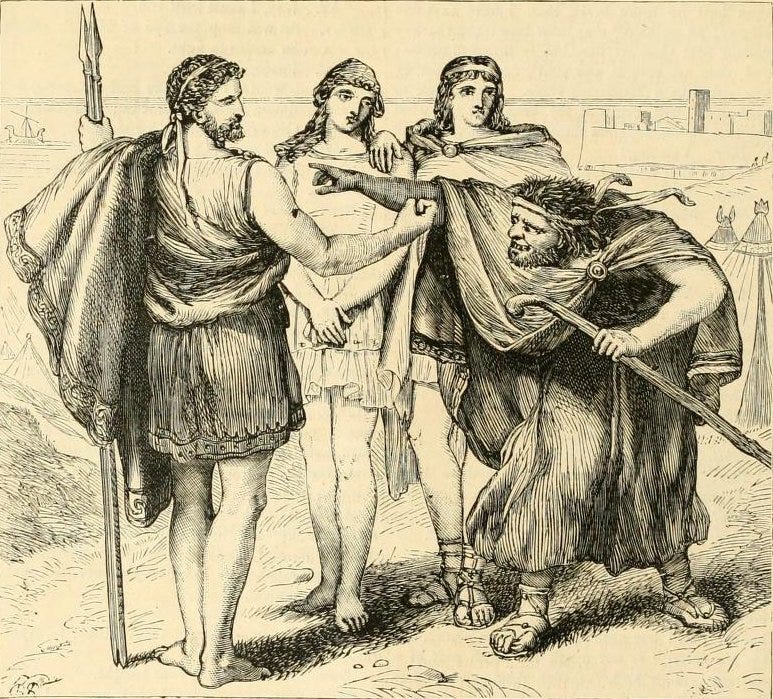
An illustration from Shakespeare’s Troilus and Cressida, wherein Thersites (right) denounces Ajax
One hardly thinks, when contemplating the great and sage writings of antiquity, that any time at all would be given to the matter of body odour therein. Far, then, would anyone who has not read Meditations evidently be from a good idea of what those sage writers thought about and wrote, for here we find Marcus Aurelius, one of the greatest Emperors of the greatest earthly Empire which ever was, meditating upon bad breath and disagreeable scents emanating from one’s underarms. Of course, this layer of discourse is naturally only an exoteric layer. For, indeed, Aurelius must be said to be warning against the crime of setting unduly high expectations upon someone, and growing angry when such a person does not meet your expectations.
Aurelius, an Emperor, certainly must have known that all people, high and low, have a station in life, and he must have known, too, that one ought not abuse that truth with one’s hope that all people would be as wise as philosopher-kings and as virtuous as saints. Such hoping is terribly wrong and ought not be entertained, for it gives an excuse to the high and the low and lowers both, the former by teaching them they needn’t be so great as they might be, and the latter by teaching them they have nothing to strive after. Thus, the teaching of such hope produces nothing but a grey mass of mediocrity and stagnation, as Aurelius, both for practical and perennial purposes, favoured the destruction of, so that a Higher state of being might be introduced to all.
*
We have in the above illustration Thersites, about whom Homer wrote the following in the Illiad:
His figure such as might his soul proclaim;
One eye was blinking, and one leg was lame:
His mountain shoulders half his breast o’erspread,
Thin hairs bestrew’d his long misshapen head.
Spleen to mankind his envious heart possess’d,
And much he hated all, but most the best:
Ulysses or Achilles still his theme;
But royal scandal his delight supreme,
Long had he lived the scorn of every Greek,
Vex’d when he spoke, yet still they heard him speak.
Sharp was his voice; which in the shrillest tone,
Thus with injurious taunts attack’d the throne.1
We should think that the rebellious spleen of Thersites arose not out of nowither but, it having been mentioned at some length, out of his being a rather automatic outcast from heroic-minded Greek society, for the fact that he was physically repulsive. Aurelius above reflects on the fact that the man with bad odour, if approached as if he were as wise as anyone else, would better reflect on the fact that he was abusing the nostrils of those near him, and would do what he could to not do so. But, instead, one merely hates him for stinking without ever telling him so! One supposes that if Thersites had not been at once mocked or silently hated, as one can imagine he was when young and continued to be as he grew to be a man, but taught rather that, despite his thin hair, grand shoulders, and lame leg, he could yet be a hero of one kind or another, he could have become so, and, had he not become so, he anyhow would not have had even half as much cause to mock the Heroes Ulysses or Achilles out of resentment, nor lamely mimic the latter in his denunciations of Agamemnon or heroic acts, for he would in no manner have seen heroism as an impossibility, but something he merely did not reach, as many other soldiers at Troy. Thus, Aurelius would have us learn good manners as well as more general virtue and to approach all our dealings with such. Of course, he teaches us also the Golden Rule, by simply causing us to consider what we might desire if, by no means we could control or even influence, we came into the world stinking and could never change our smell, or came into it with a lame leg and could not walk properly.
No Vulgar Retreat Shall Afford Peace
They seek for themselves private retiring places, as country villages, the sea-shore, mountains; yea thou thyself art wont to long much after such places. But all this thou must know proceeds from simplicity in the highest degree. At what time soever thou wilt, it is in thy power to retire into thyself, and to be at rest, and free from all businesses. A man cannot any whither retire better than to his own soul; he especially who is beforehand provided of such things within, which whensoever he doth withdraw himself to look in, may presently afford unto him perfect ease and tranquillity. By tranquillity I understand a decent orderly disposition and carriage, free from all confusion and tumultuousness. Afford then thyself this retiring continually, and thereby refresh and renew thyself. Let these precepts be brief and fundamental, which as soon as thou dost call them to mind, may suffice thee to purge thy soul throughly, and to send thee away well pleased with those things whatsoever they be, which now again after this short withdrawing of thy soul into herself thou dost return unto. For what is it that thou art offended at? Can it be at the wickedness of men, when thou dost call to mind this conclusion, that all reasonable creatures are made one for another? and that it is part of justice to bear with them? and that it is against their wills that they offend? and how many already, who once likewise prosecuted their enmities, suspected, hated, and fiercely contended, are now long ago stretched out, and reduced unto ashes? It is time for thee to make an end. As for those things which among the common chances of the world happen unto thee as thy particular lot and portion, canst thou be displeased with any of them, when thou dost call that our ordinary dilemma to mind, either a providence, or Democritus his atoms; and with it, whatsoever we brought to prove that the whole world is as it were one city?
Book Four, III
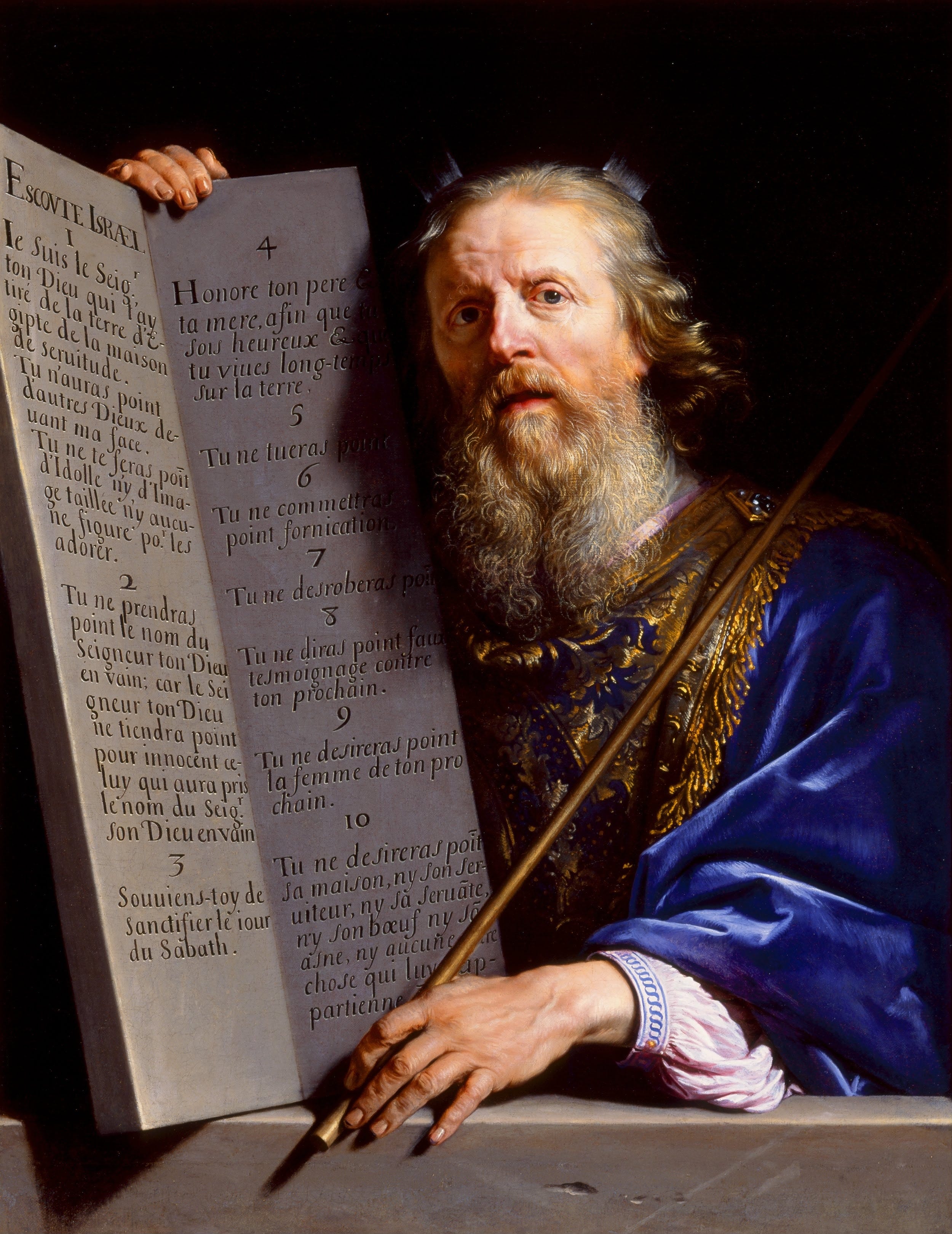
Moses Presenting the Tablets of the Law, Philippe de Champaigne, 1648
In the book I have lately finished, Drunk on Misery, I reflect on the Norwegian nihilist Peter Wessel Zapffe’s retreat from society into nature as well as Nietzsche’s aesthetic retreat from society—the raising of oneself as the Übermensch over the crowd which makes up society. So far as my reflections go, they cannot be said to be so far from those of Aurelius. He teaches us that no retreat which is vulgar or earthly—either a physical or mere aesthetic retreat, as some think the Wanderer in the already meditated upon Caspar Friedrich painting was making—can be pleasing unto one’s soul, for the fact that these retreats fail to acquaint us with the necessary spirit to face society and ourselves. Zapffe allows himself to give up altogether and hide from society, as did the Romans of old whom the Emperor Aurelius regards as not truly understanding what it is to be tranquil or to retire, and as is unnatural. Meantime, the Nietzscheans—most especially those of today, the sort of pop-culture Nietzscheans, as one might call them—provide themselves a sort of excuse to do nothing by dreaming of having made an aesthetic or psychological retreat from society, which permits them to seldom teach themselves anything which truly might aid them in living, and which doubly permit them to fail to bring themselves into friendship and co-operation with the spirits which truly make someone virtuous, good, and worthy of being called free from all confusion and tumultuousness, so that now they have only an excuse to embrace nihilism and the freedom of a nihilistic lifestyle.
Aurelius, as we have seen above twice now, was inclined to thinking man was better in his natural condition, sociability, than in one of retreat from one’s fellows, as he teaches when he says, For what is it that thou art offended at? Can it be at the wickedness of men, when thou dost call to mind this conclusion, that all reasonable creatures are made one for another? Of course, he was an Emperor, and one must reflect it was an impossibility that a truly good and just Emperor could ever retreat from society in order to save himself the woes of life and existence beside other creatures. Rather, he had to retreat only into his own soul for a period, that he might return with a better attitude and a heart more prepared to face his citizens. Then, we learn from the example of his good governance and his wise words, all of which he gave to us during but temporary retreats, that it is impossible to be best while outside the company of one’s fellows. A retreat can only be temporary.
We have above an extremely fine picture of Moses by Philippe de Champaigne. Let us consider Moses somewhat, we having so fine a picture of him above! To try to do less than abuse a word in fashion today, we might endeavour to learn a lesson from the book of Exodus, which teaches a perennial lesson by showing that it was Moses elected to depart from his people into the mountains to receive the tablets bearing the law of God, not a lone-wolf. Of course, we can think very easily that it would never have been a retreater—a countryside-dweller, a traitor to the natural instinct to be social, who would prefer to barbeque for himself and care little for man and flatter himself by considering himself a lone wolf—chosen for so profound a role in human events. We are given by his story a further proof that sociability, not reclusion, is favoured by a providence, or Democritus his atoms. And that is perhaps the finest lesson to be learnt from Moses, that strange man described by Tacitus as the establisher of the world’s most unique creed: Providence, or Democritus his atoms—that is, in either case, humanity’s cause of existence—favours those who live according to its finest earthly creation, nature, whose greatest demand of us is that we might live according to its will, which is one that orders us to live sociably and not in seclusion. What Marcus, a friend of nature, should like us to know, to be put things as briefly as possible, is that while we must meditate within our own company, we cannot retreat from society to do so, for it would be purposeless and, he suggests, ineffective to both ourselves and others.
Surrender as Little as a Cliff to the Ocean
Thou must be like a promontory of the sea, against which though the waves beat continually, yet it both itself stands, and about it are those swelling waves stilled and quieted.
Book Four, XL
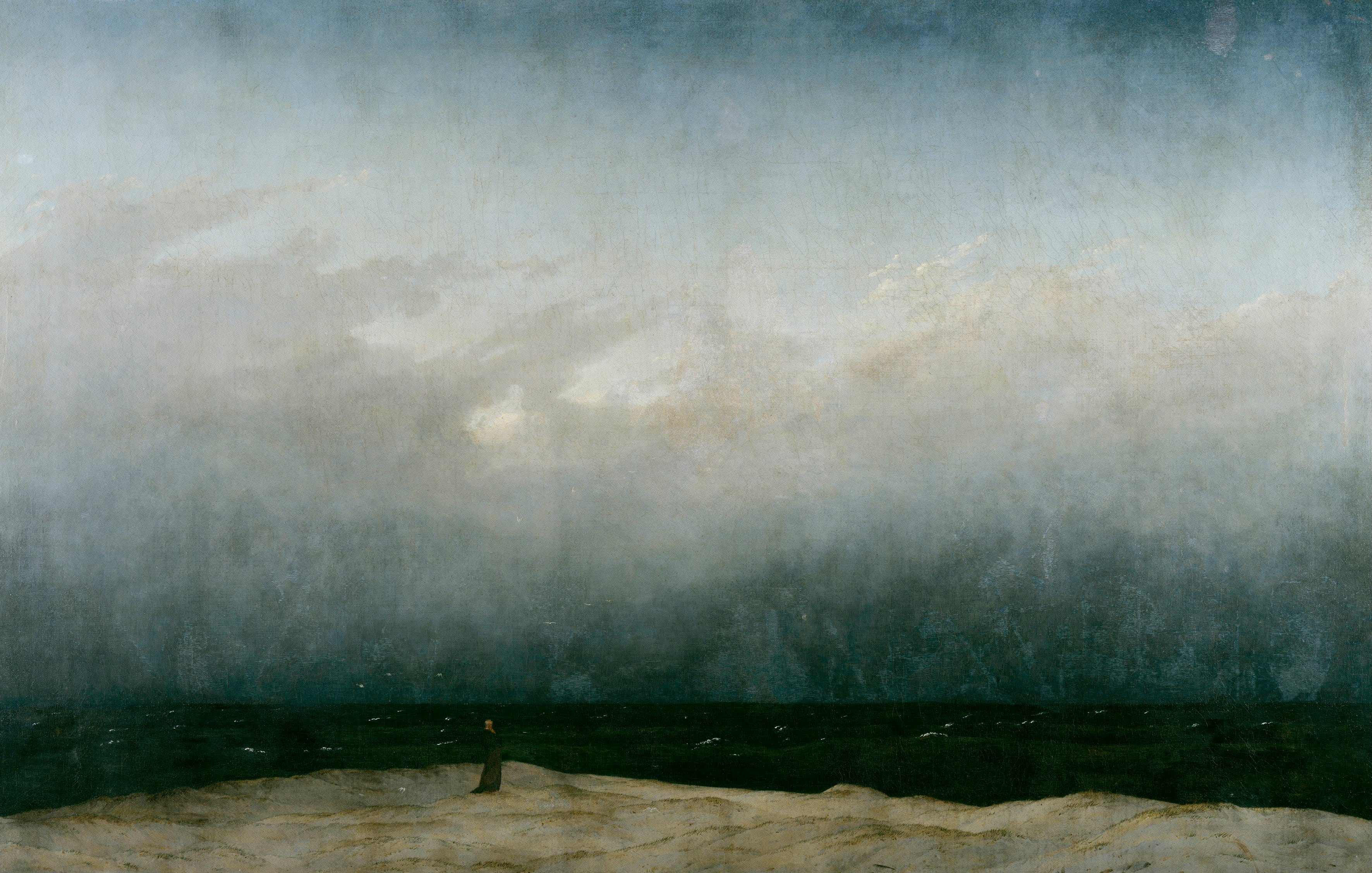
The Monk by the Sea, Caspar David Friedrich, 1810
When one thinks of the philosophy of the Stoics, which was not so much a philosophy as a river out of which various geniuses fished ideas in order to make their own personal philosophy, which philosophies have been variously called Stoicism, one thinks probably first of the word stoic. When that word is brought into one’s head, one thinks of being forbearing, of hardly facing adversity with any dramatics and certainly no histrionics, and of being, really, if we should elect any historical example, Emperor Marcus Aurelius as he is nearly fatally ill, faced with being usurped by his wife and her lover, and the Germanic front to maintain. He did not weep or retreat from life or allow himself to die, but rather made himself rather like a cliff and stood firmly against the stormy sea rushing down upon him, and came out on the other end of the tempest yet standing.
Naturally, I should think it is little offensive to anyone that I have taken two works from Caspar Friedrich to fill up this gallery, for his romantic works generally endeavour to marry nature with a certain stoicism in man. Thus we have Wanderer, as well as Monk. In both cases, we see a lone man facing a nature which he could never defeat. As one cannot defeat nature, one cannot so commonly defeat the great adversities of life and existence. As he says, Emperor Aurelius should like us not to weep or grow fierce about life, but stand facing hardship much like the cliff standing under the monk and keeping him from the sea which would swallow him and keep him in its sway before delivering him, dead, to the rocks or the sand. Should one stand like a cliff or a stonewall, one shall not only be contented with both the ups and downs, but survive both better while remaining oneself, having surrendered no part of oneself to live through either, as some do and have always done.
The Virtuous Life
Never esteem of anything as profitable, which shall ever constrain thee either to break thy faith, or to lose thy modesty; to hate any man, to suspect, to curse, to dissemble, to lust after anything, that requireth the secret of walls or veils. But he that preferreth before all things his rational part and spirit, and the sacred mysteries of virtue which issueth from it, he shall never lament and exclaim, never sigh; he shall never want either solitude or company: and which is chiefest of all, he shall live without either desire or fear. And as for life, whether for a long or short time he shall enjoy his soul thus compassed about with a body, he is altogether indifferent. For if even now he were to depart, he is as ready for it, as for any other action, which may be performed with modesty and decency. For all his life long, this is his only care, that his mind may always be occupied in such intentions and objects, as are proper to a rational sociable creature.
Book Three, VIII
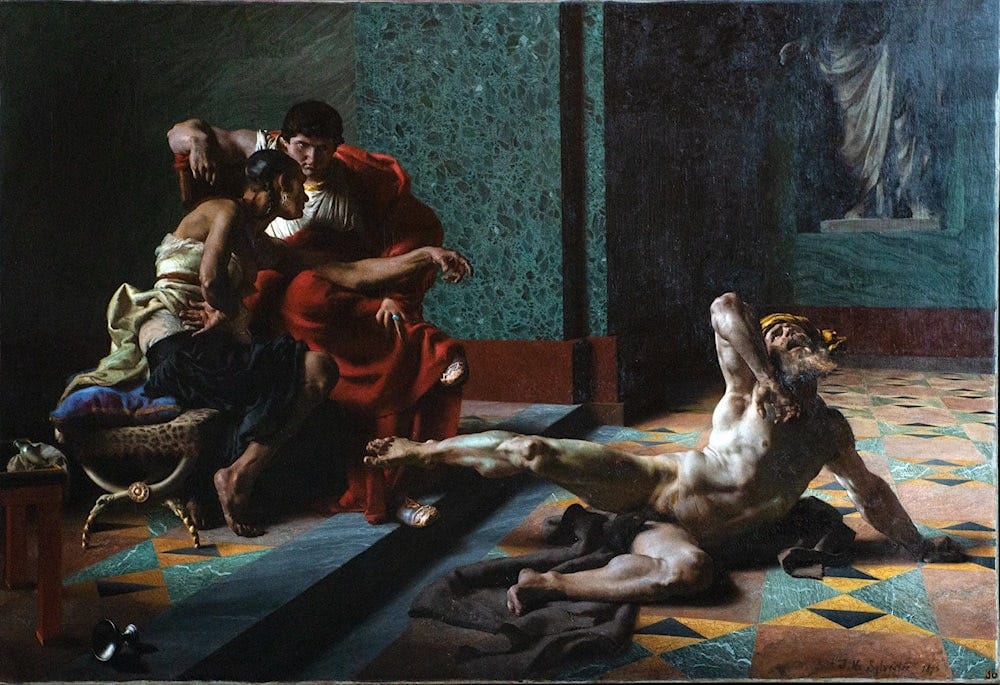
Locusta testing in Nero’s presence the poison prepared for Britannicus, Joseph-Noël Sylvestre, 1876
We can see Aurelius’ theory of the good life proven true by the example of a life lived in the antithetical manner—i. e., the life of no virtue. How awful was the life of someone whose history Aurelius was familiar with and which he referenced in his Meditations—that of Nero, the Emperor of Rome after Claudius, his step-father. Nero plotted assassinations behind veils, including that of his mother, Agrippina the Younger, and his step-brother, Britannicus, lusted after just about anything—fleshly or not—he saw which he supposed would bring him pleasure, broke his faith to be the guide of the people under his imperium, was immodest, cursed and hated nearly all peoples on earth, and certainly viewed all these things as in some manner profitable. His life, a thing of only thirty orbits, was ended by an assassination. With him was ended the Neronian dispensation, which could, had he been virtuous, have been just as good to man as that of Aurelius or any of the good Emperors.
Aurelius’s education teaches us that if we begin to act as he instructs—if we endeavour to never again do anything that requires us to betray our vows, to be immodest, to hate our fellows or curse or suspect them, to lower ourselves to lust, or to hide our intentions—virtue shall be natural to us for all our lives, and we shall never become Neronian. Contrary to those teachings and that spirit more common to us today, which tell us there is only so much we can do to better our moral character before an inert evil keeps us from growing better, Aurelius teaches us that it is up to us just how far along virtue’s path we shall go.
Philosophise Ever
The time of a man’s life is as a point; the substance of it ever flowing, the sense obscure; and the whole composition of the body tending to corruption. His soul is restless, fortune uncertain, and fame doubtful; to be brief, as a stream so are all things belonging to the body; as a dream, or as a smoke, so are all that belong unto the soul. Our life is a warfare, and a mere pilgrimage. Fame after life is no better than oblivion. What is it then that will adhere and follow? Only one thing, philosophy. And philosophy doth consist in this, for a man to preserve that spirit which is within him, from all manner of contumelies and injuries, and above all pains or pleasures; never to do anything either rashly, or feignedly, or hypocritically: wholly to depend from himself and his own proper actions: all things that happen unto him to embrace contentedly, as coming from Him from whom he himself also came; and above all things, with all meekness and a calm cheerfulness, to expect death, as being nothing else but the resolution of those elements, of which every creature is composed. And if the elements themselves suffer nothing by this their perpetual conversion of one into another, that dissolution, and alteration, which is so common unto all, why should it be feared by any? Is not this according to nature? But nothing that is according to nature can be evil.
Book Two, XV
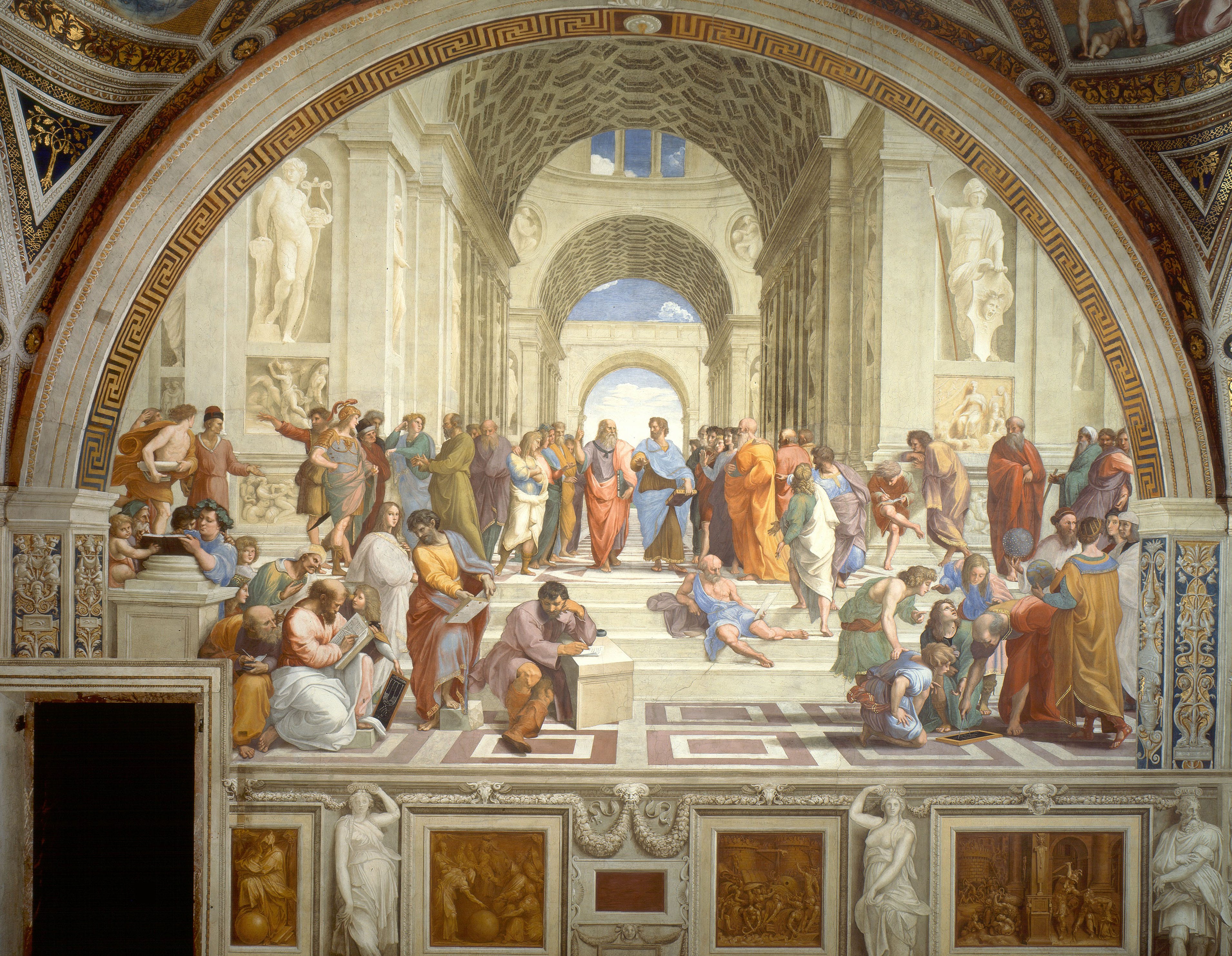
The School of Athens, Raphael, 1511
To dwell, as it were, in your own sort of Akadimia Platonos and philosophise perpetually is, for Aurelius, the highest pursuit and, thus, the highest good of life, the doing of which is seen as the door taken to enter into a life of simple beauty, love, the production of a harmonious political state, and all else good, rather than a mere end in itself. Naturally, then, we have one of the greatest known paintings to accompany this closing of Aurelius’ second book, composed while he was at Carnuntum. Plato’s Academy, which is here depicted by Raphael, was the first place in all the world to place right philosophising as simultaneously the endeavour of education and the fruit to come from it—a thing which could properly never be ended, but which it was anyhow beyond well to begin.
It is rather clear from Raphael’s choice of models that he was in agreement with Aurelius’ will to philosophise, for in the School of Athens we find him presenting those most philosophical of souls, rather than the most fanatic or superstitious, as members of Plato’s Academy. For those of the Italian Renaissance tradition generally called Humanism, Plato was seen as the highest of philosophers, as compared with Aristotle for those of a rather more traditional Catholic manner of looking at things. Thus, we see Leonardo da Vinci as Plato, who holds his hand up towards the heavens while Aristotle is seen holding his hand flat down and facing the earth, signalling the latter’s occupation with definitions of existence as it is, rather than as it must be. Naturally, the Humanists, who were much more mystical and philosophical than they are often thought to have been, favoured Plato, who described in most ways the perfect state of being, earthly and heavenly, rather than the existing one. One can likewise see in Aurelius a Platonic view of things, and thus it is little wonder that he drew Plato’s lines so often into his own meditations. Naturally, however, there is a place for Aristotle in Aurelius’ view of life and philosophy, and also one for the Humanists of the Renaissance, who, after all, did not altogether wish to see him excluded from the perfect academy.
Life’s Stage
To stir up a man to the contempt of death this among other things, is of good power and efficacy, that even they who esteemed pleasure to be happiness, and pain misery, did nevertheless many of them contemn death as much as any. And can death be terrible to him, to whom that only seems good, which in the ordinary course of nature is seasonable? to him, to whom, whether his actions be many or few, so they be all good, is all one; and who whether he behold the things of the world being always the same either for many years, or for few years only, is altogether indifferent? O man! as a citizen thou hast lived, and conversed in this great city the world. Whether just for so many years, or no, what is it unto thee? Thou hast lived (thou mayest be sure) as long as the laws and orders of the city required; which may be the common comfort of all. Why then should it be grievous unto thee, if (not a tyrant, nor an unjust judge, but) the same nature that brought thee in, doth now send thee out of the world? As if the praetor should fairly dismiss him from the stage, whom he had taken in to act a while. Oh, but the play is not yet at an end, there are but three acts yet acted of it? Thou hast well said: for in matter of life, three acts is the whole play. Now to set a certain time to every man’s acting, belongs unto him only, who as first he was of thy composition, so is now the cause of thy dissolution. As for thyself; thou hast to do with neither. Go thy ways then well pleased and contented: for so is He that dismisseth thee.
Book Twelve, XXVII
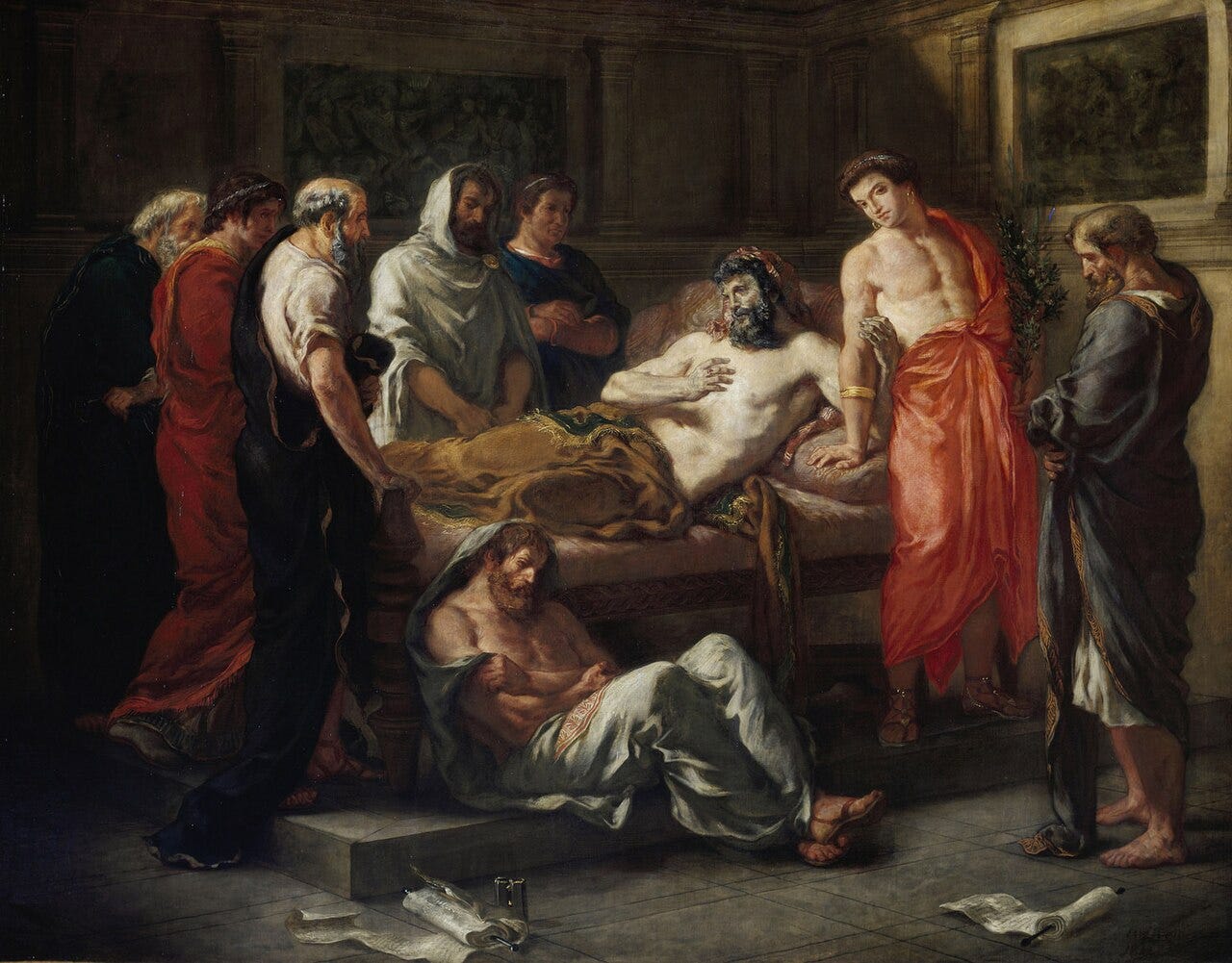
Last Words of the Emperor Marcus Aurelius, Eugène Delacroix, 1844
Here we have, suitably, the final lines from Emperor Aurelius’ Meditations. As Augustus went out from the earth, he asked that those gathered around him, if they judged he had played his part upon life’s stage well, would clap as he went and ascended. Hither we find Aurelius teaching us all to treat life as a stage, so that we do not begin to think ourselves permanent players upon earth’s stage, but mere temporary creatures meant for a destiny of impermanence here and, the Emperor believed, permanence in a higher plane of living. Further, Aurelius teaches us to be as pleased and contented with our playing upon the stage of life as God, who dismisses us from the stage when we have committed our actions and spoken our lines.
So far as the theme of plays goes, for Aurelius, it is absurd to prefer having many lines—that is, a great role—in a play than a role which commits the most to the stage in way of performance, no matter how great or small the role is in terms of time or perceived profundity. After all, it can often be the case that a role of seemingly little importance, as Shakespeare’s many examples prove, is used to utter the finest of lines. So, the actor who plays his role well, no matter how great or small, is infinitely superior to he who plays the longest-lasting role and who sleeps through the better half of it, suffering only occasional moments of energy. Along this line, as has already been pointed towards, Aurelius speaks of the absurdity to desire to act after the demands of your role have run out. In denouncing this, Aurelius speaks of a sort of life denial, insofar as the person who desires first to act rather than act well is seen as someone who would live merely for living’s sake, or out of fear, rather than out of a desire to live well.
Alas for us, we have already had Macbeth amongst our illustrations. Had we not, perhaps now it would be well to see him placed hither, along with his memorable lines from tomorrow, and tomorrow, and tomorrow.2 But it is well enough that we do not have him here properly, for it must be said that Macbeth did not play his role just as Aurelius advised him to. In our painting, instead of Macbeth, we find none other than the Emperor himself, the author, whom we ought to be thankful for, he having given us such lasting reflections and such room to discourse upon these pictures, all of which, I think, are given greater purpose and meaning by this marriage of prose and paint. And we have him at the close of his life, making his last utterances. Though they were not heeded by those whom it would have most benefitted the world to see them heeded by, let us heed them. It must be said, finally, as a point of compliment to both him and the validity of his philosophy, that Aurelius played his part very well and did not protest at its end, though the world-play had not ceased.
Trans. by Pope
Macbeth’s famous soliloquy in the play bearing his name. He speaks it just before he leaves earth, his castle having been stormed and his wife having been slain. Indeed, it is in reply to Lady Macbeth’s death that he speaks these following lines:
Tomorrow, and tomorrow, and tomorrow
Creeps in this petty pace from day to day
To the last syllable of recorded time;
And all our yesterdays have lighted fools
The way to dusty death. Out, out, brief candle!
Life’s but a walking shadow, a poor player
That struts and frets his hour upon the stage
And then is heard no more. It is a tale
Told by an idiot, full of sound and fury
Signifying nothing.