
Why the Vikings Weren't 'Based'

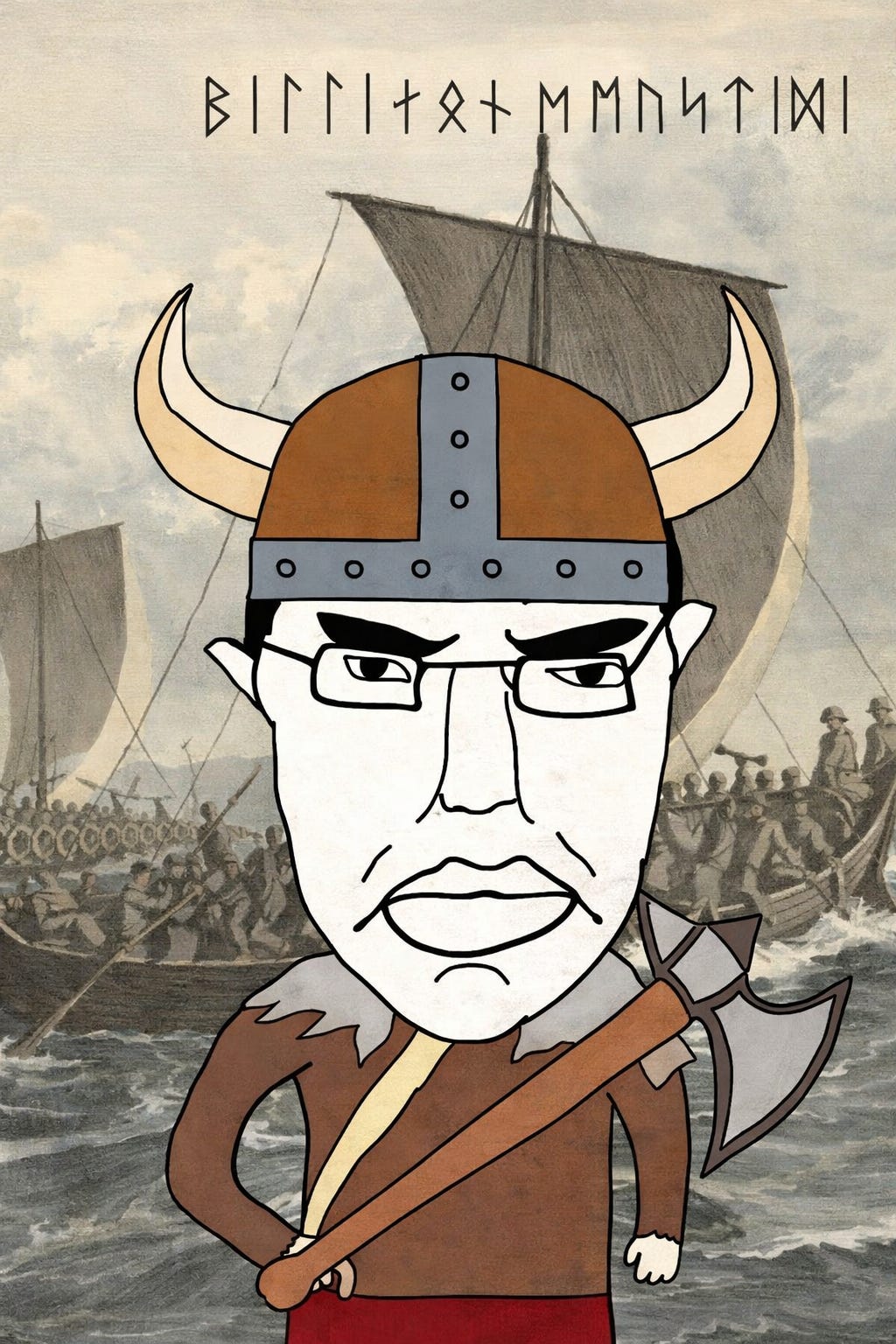
I do not know who made this image, but well done as it is very funny.
Prepare yourselves for a slave-morality so intense the Übermensch melts away in terror at the first whiff of it.
Also, one criteria: I qualify as ineligible for basedness those groups and parties which mass murder people. . . See above note for explanation.
Welcome, all, to my scheduled Christmas gift to Substack. I must first begin by giving due acknowledgment to the so-called ‘Based Pagans’.1 Gentleladies and Gentlemen, Comrade Based Pagans, Heirs to the Vikings, I beg your forgiveness, if you feel I must beg the granting thereof unto me, a mere gentleman scholar, for this, my most blasphemous study of Viking life. Now, because it is the Holidays, I’ll just leave you with five or ten minutes worth of fun notes. Sit round the fire and, between Dickens, have a little laugh with me at our Viking ancestors. Being short on time, let’s just quickly hit the trail in search of these ancestors, whose unwashed bodies, thankfully, leave a scent so overwhelming one can find them without help.
The Violence Problem
The chief problem with the Vikings is this, the Violence Problem. I judge it leaves them looking, rather than ‘based’, like the occupants of a rather sad little chair meant for petulant children which one sits in the corner of a dining room. Vikings are commonly regarded as having had three life-passions: R*pe, Murder, and Pillage. These three acts, save in rare cases the third, are liable to be thought by all minds as inherently violent. Thus, the overwhelming majority of minds quickly regard them as bad. I say all this only to establish myself amongst the majority, as well as subtly sway you to my position with haste, as really things might become shaky and it’s well enough to gain support with an initial bang.
Now, were these acts committed only by the Vikings? No, not really, though it must be said that most other cultures and civilisations did not make it such a constant friend of what they regarded as progress and, indeed, civilisation itself. That is the problem. Whereas, let us say, the Carolingian Empire was built from the crumbled foundations of Western Rome, was united by a tradition which warmed the hearts of its citizens and aided the doing of much good, tried to maintain a peaceful manner of living, and even had its own font2—so scholarly was it—the Viking Empire—what of it there ever was—was built by bands of hooting and hollering drunkards stumbling through Europe with swords, axes, spears, and much else, just a-hackin’ and pokin’ away at anyone who might ask them to calm down and return to the wives, children, and sick back home, whom they had left to do the hard labour of freezing away and chewing on dilapidated foods grown earlier in the year. This latter Empire, to my mind, while in the mind of a select few was a thoroughly ‘based’, marauding, Overman-morals-possessing, and folkish (or whatever other idiotic word one might think to use) society, was hardly an agreeable or useful one. Indeed, what evidences do we have that it was ever anything more than that? From the Viking era, do any great buildings remain with us? Do we have more than a handful of ‘their’ books (which I shall get to in a minute)? Anything decent? No. What were its works? Whatever they were, they were made up of extreme and constant idiotic violence. We know this to be so, as otherwise they would have left some record of themselves doing something else somewither or other. Even their meagre little explorations didn’t help a thing, for wherever they went, they went not in search of anything Good or even decent, but only in search of some new lands, virgin to their eyes, which they could destroy.
Instead of building much at all of their own, they decided to have a yearly romp in some or other foreign territory, wherein they would do their best to tear to bits and shreds any useful thing built by the inhabitants of such a territory, stealing their achievements and Beauty and replacing both with a scavenged, blood-filled hole. This is the based society we are supposed to retvrn to? I shall remain here, thanks.
But, comes the call, the Vikings were not actually very violent. To suggest anything else is to embrace anti-Viking propaganda! Is it really, then? No, it’s not. That the Vikings can avoid being classed almost universally as men of violence seems impossible to me. After all, with what natural ease, one knows, some SS-dunce thought to call the SS volunteer division from the Norseland. . . let us see. . . ah, yes, the Wiking Division. And what good Wikings the SS men at Stalingrad were, wandering aimlessly, pillaging, murdering, r*ping.
I judge that the brilliantly composed Nibelungenlied tells us exactly about the depravity and impotent violence of the Germano-Viking Age. The rare Siegfried is cast as the noble, useful man, filled profoundly with a duty to his fellow men to do what is Good, to not unduly bother others, whereas his murderer Hagen and the plotters behind the murder represent the common Viking: a useless, greedy, lazy pillager with a lust for that which is not owed him, who had rather just take the success of another person, and peoples, than gain it for himself.
Comrade Based Pagans, respice finem: look to the end. Yes, the longships and sheepskins and free-spiritedness of the Viking warriors may look agreeable on camera, but what is—indeed, what was—the end of it? A very great deal of unnecessary killing, butchering, r*ping, pillaging all through the Europe which the modern admirers of Vikings ostensibly care so much about! This is your legacy? Be off, then, as I’ve not a bloody moment of my time to spare you!
Blóts were a blótty impious mess
Aside from the mass murder of various peasants and priests across Europe, Vikings also went in for mass murder back home: only, this mass murder was not of their fellow humans, but of animals. . . Sacrificing animals (and sometimes people!) in order to please the gods is not something which ought to be said to have been uncommon. It cannot be said to have ever been a very useful way of passing the time, either, however. To be sure, all societies—even some great ones—passed through their Blót-phases, but they eventually freed themselves from them, having contemplated and, thus, having been blessed with better methods of pleasing God.
St Theresa of Avila said quite wisely, ‘You pay God a compliment by asking great things of Him’. Of course, the logic is clear—it suggests that God is great enough to, as it is said, move mountains, would you only ask Him. Now, conversely, the idea of the Vikings surrounding asking things of God and the gods over whom He ruled, was that the best He could do was secure them nice tillage the following year, paired with good luck in their aforementioned murdering, and only if they sent a few pig carcasses His way. This is not, in my view, a very impressive view of God, nor a true one.
Anarcho-Iceland-ism: The Other Side of Viking History
This section is designed for the pleasure of the Based Pagans, as it shall appear to them to be a critique, from what they may call ‘the Nietzschean perspective’, of the boring group of Vikings who dwelt calmly in Iceland for some centuries. Herein, I shall claim nothing more than the truth of the Iceland Vikings: namely, that they were what Nietzscheans would regard as boring farmers, too dull and agreeable to even make government for themselves.3 This is certainly un-Pagan, un-life-affirming (a phrase I have now read uttered by so many morons that I can no longer use it without a groan and subsequent nausea), and so on. But is it also bad? I think not. Rather, it is also nice, really. I can easily imagine enjoying a life of some leisure, commerce, and friendly tradition amongst the Vikings of Iceland. Being given an opportunity to dwell amongst the Vikings of Norway during the bloody Pagan-adventuring days, I think I would certainly think to acquire a return ticket before I acquired the first one…
The other agreeable fact of Anarcho-Icelandic life was that it was here the ‘Vikings’—these, we must know, are the Icelandic Vikings, the heirs of the calm, rational explorer Vikings, whose society had progressed in morals and much else quite considerably from the Viking societies of the ninth, tenth, and eleventh centuries—wrote a few books for themselves, having found that a life of leisure allowed for such things. It was from these Iceland farmers that we got the best books from the Viking days: The Poetic Edda, Völsunga saga, Vinland sagas, etc (but not etcetera too blótty far, that being impossible!).
In the Vinland Sagas, we are shown the admirable side of the Iceland Vikings. They were explorers, noble farmers, and desired to do Good rather than ill—generally!
The Good Thing Vikings did
Amongst the charitable deeds of the Norsemen Ubermenschen chads is one of particular historical weightiness: the construction of England. Thanks, you blood-soaked hooch hounds! You caused our English ancestors to deny themselves the parochial gaiety of Heptarchy and draw themselves together to give a general defence of the Realm with one United Kingdom. Skál!
Yes. . . and no
Yes, my name is Trygve. Yes, to be sure, some small portion of my ancestors went rolling over the seas in search of blood to unnecessarily let. No, I’m not terribly proud of that era of Norwegian history. All this being said, I do understand how such frozen conditions could inspire a certain anger and consequent will-to-destroy in a society. But this is only a little excuse, as plenty other cold-peoples got on much better with their civilisational project than the Vikings, and they, naturally, suffered the cold just as thoroughly as any one Viking or other.
Lastly, I suppose all this essay is the result of my inability to use the word ‘based’ in anything but an ironic manner. O well. Merry Christmas, ye who celebrate.
This I must think are different in some way from the ordinary Pagan, as the Based Pagan sees Paganism as a mere political accessory. About Paganism itself I really don’t have much to say. My only light comments on it are to be found in the section ‘Blóts were a blótty impious mess’.
See Carolingian minuscule.
For a great many years, the Vikings of Iceland existed without any central force, merely co-operating with one another and following a sort of law which had been whilom ’stablished to keep away the ne-er-do-well instinct within a portion of their society.
Yakub would be proud that’s such a condemnation of Viking brutality! Evil white people, amirite!?
Seriously though, I think you generalized this Viking tendency towards ruthlessness a little too much. Are you familiar with the theories that Viking Berserkers were pretty much incels and low lives, rounded up and sent abroad as a utilitarian strategy? I think that would be a better explanation.
I really enjoyed your prose.
God I wish I was born a Viking.